OPEN ACCESS STATEMENT: Rozprawy Komisji Językowej is an open-access, peer-reviewed academic journal published by Łódzkie Towarzystwo Naukowe (Łódź Scientific Society).

Starting from 2024, all articles are published under the CC BY 4.0 (Attribution 4.0 International) Creative Commons License
Previous years: articles were published under the CC BY-NC-ND 4.0 (Attribution–NonCommercial–NoDerivatives 4.0 International) Creative Commons License.

COPYRIGHT:  Starting from 2025 Authors retain full copyright to their articles. By submitting for publication, they grant the publisher a non-exclusive, royalty-free license to publish and disseminate the accepted version. Authors may deposit the publisher’s final version of the articles in institutional and subject repositories without embargo, in accordance with the CC BY 4.0 license.


Announcements

Current Issue

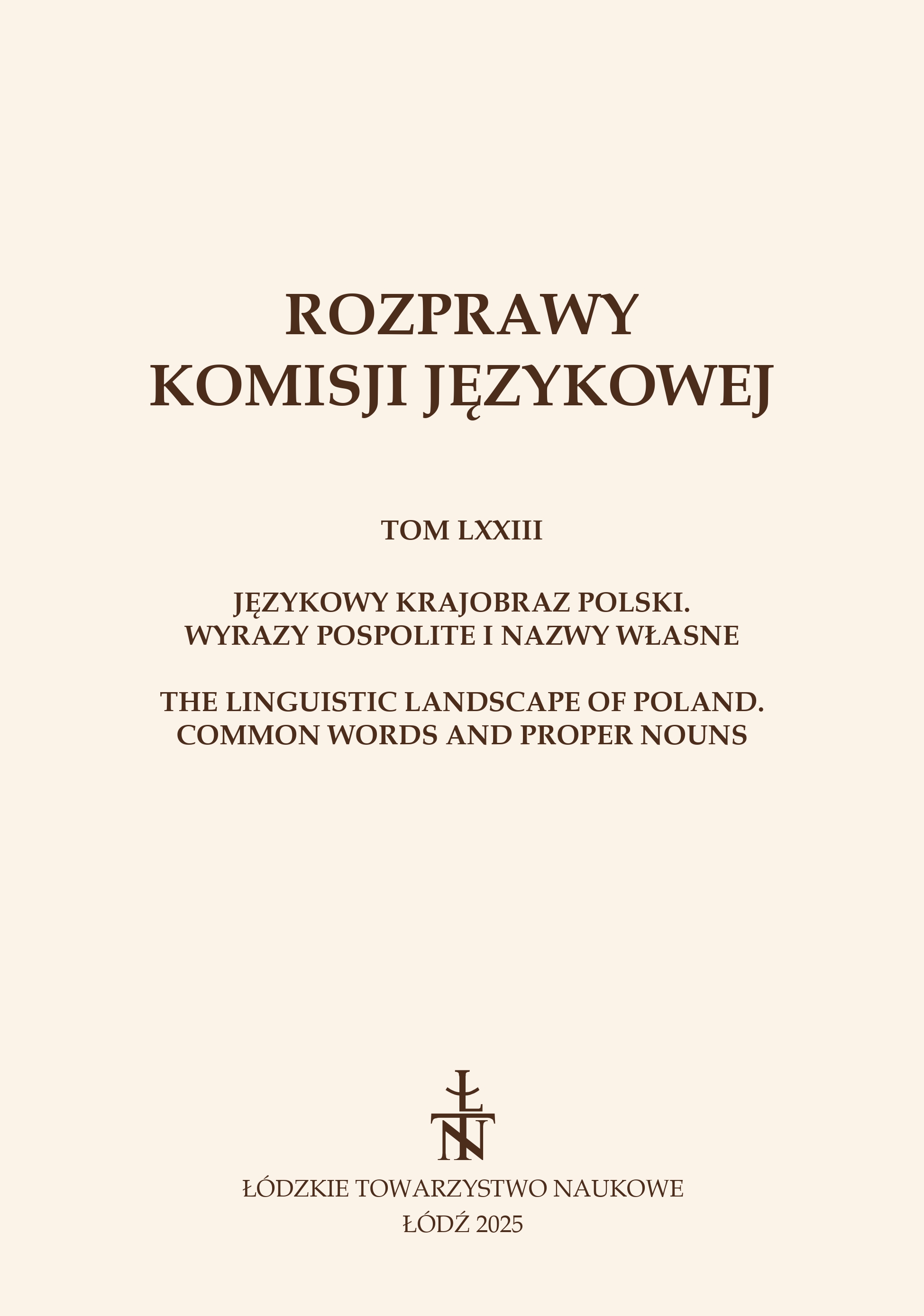
Vol. 73 (2025): THE LINGUISTIC LANDSCAPE OF POLAND. COMMON WORDS AND PROPER NOUNS
					View Vol. 73 (2025): THE LINGUISTIC LANDSCAPE OF POLAND. COMMON WORDS AND PROPER NOUNS

VOLUME EDITORS: Irena Jaros, Halina Kurek, Stanisław Cygan

Co-financed by the Minister of Culture and National Heritage from the Promotion of Culture Fund

mceclip8-303010015ba913aa6099bd88af6c6387.png

Published: 2025-12-02

EDITORIAL

  • Od Redakcji

    13-14
    DOI: https://doi.org/10.26485/RKJ/2025/73/0

ARTICLES

  • From Szczebrzeszyn to the Department of Marie Curie-Skłodowska University in Lublin. A Sketch for a Portrait of Professor Halina Pelcowa

    Stanisław Cygan
    15-49
    DOI: https://doi.org/10.26485/RKJ/2025/73/1
  • Polish-East Slavic Borderland as Exemplified by Włodawa Anthroponymy

    Feliks Czyżewski
    51-73
    DOI: https://doi.org/10.26485/RKJ/2025/73/2
  • From the History of Dialectology. An Unknown Page of the Sejny Dialect’s Past

    Stanisław Dubisz
    75-86
    DOI: https://doi.org/10.26485/RKJ/2025/73/3
  • Polish-Ukrainian Lexical Relations in the Light of Research by Professor Halina Pelcowa

    Agnieszka Dudek-Szumigaj, Marek Olejnik
    87-97
    DOI: https://doi.org/10.26485/RKJ/2025/73/4
  • The Word Formation of Dialectal Resultative Nouns

    Beata Gala-Milczarek
    99-108
    DOI: https://doi.org/10.26485/RKJ/2025/73/5
  • Vocabulary Associated with Ceremonies of the Church Year in Halina Pelcowa’s "Dialect Dictionary of the Lublin Region"

    Barbara Grabka
    109-119
    DOI: https://doi.org/10.26485/RKJ/2025/73/6
  • "Słownik gwar Lubelszczyzny" ("A Dialect Dictionary of the Lublin Region") by Professor Halina Pelcowa as a Source of Knowledge and Inspiration in Regional Education

    Ilona Gumowska-Grochot
    121-131
    DOI: https://doi.org/10.26485/RKJ/2025/73/7
  • On the Geographical Exposition of Polish Synonymous Adjectival Derivatives

    Irena Jaros
    133-144
    DOI: https://doi.org/10.26485/RKJ/2025/73/8
  • Functions of the Wives’ Names in a Traditional Rural Society (on the Example of Truskolasy Next to Częstochowa)

    Tomasz Jelonek
    145-156
    DOI: https://doi.org/10.26485/RKJ/2025/73/9
  • More About the Dialect Words "Zajda", "Zajdy", "Zajdki", Their Variants and Derivates

    Halina Karaś
    157-171
    DOI: https://doi.org/10.26485/RKJ/2025/73/10
  • History of the Polish Spiš Recorded in the Dialect Dictionary (from the Works on the an "Illustrated Dictionary of the Spiš Dialect and Culture")

    Józef Kąś, Maciej Rak
    173-186
    DOI: https://doi.org/10.26485/RKJ/2025/73/11
  • Lexis of the Thematic Microfield "STORM" in the Language of the Inhabitants of Greater Poland (Part 1)

    Justyna Kobus
    187-198
    DOI: https://doi.org/10.26485/RKJ/2025/73/12
  • Krajna and Lublin Region – Lexical Parallels (on the Basis of Culinary Terms)

    Krzysztof Kołatka
    199-214
    DOI: https://doi.org/10.26485/RKJ/2025/73/13
  • "Kałmuk' in Polish dialects

    Katarzyna Konczewska
    215-227
    DOI: https://doi.org/10.26485/RKJ/2025/73/14
  • Lexemes "Brejdak", "Brejdaczka" in Various Varieties of Polish Language

    Renata Kucharzyk
    229-241
    DOI: https://doi.org/10.26485/RKJ/2025/73/15
  • "Totyz" – the Mysterious Name of a Lady’s Thumb Plant ("Polygonum Persicaria" L.) Used in the Dialect of the Podhale Region

    Ilona Kulak
    243-252
    DOI: https://doi.org/10.26485/RKJ/2025/73/16
  • Peasant’s Field as a Value

    Halina Kurek
    253-264
    DOI: https://doi.org/10.26485/RKJ/2025/73/17
  • Halina Irena Pelc (Pelcowa) from the House of Bartnik – in the Circle of the Name and Surname of the Jubilarian

    Renata Marciniak-Firadza
    265-281
    DOI: https://doi.org/10.26485/RKJ/2025/73/18
  • The One Who Knows, Speaks, and Acts: The Linguistic Image of Healing Preserved in Folk Healers’ Names

    Marzena Marczewska
    283-300
    DOI: https://doi.org/10.26485/RKJ/2025/73/19
  • "A White World, a Yellow Flower in It…" Polish Folk Worldview: Distortion or Transparency?

    Stanisława Niebrzegowska-Bartmińska
    301-319
    DOI: https://doi.org/10.26485/RKJ/2025/73/20
  • Culinary Customs from Fat Thursday to Holy Saturday in the Language and Culture of the Inhabitants of Konin and the Surrounding Area

    Błażej Osowski
    321-332
    DOI: https://doi.org/10.26485/RKJ/2025/73/21
  • Some Remarks on My Native Lasowiak Dialects

    Kazimierz Ożóg
    333-343
    DOI: https://doi.org/10.26485/RKJ/2025/73/22
  • Dialectal Expressive Lexis Referring to a Person – Analysis of Selected Examples from Southern Lesser Poland from a Receiver’s Perspective

    Anna Piechnik
    345-360
    DOI: https://doi.org/10.26485/RKJ/2025/73/23
  • On Several Neoregionalisms Related to Urban Transport in Poznań

    Anna Piotrowicz-Krenc, Małgorzata Witaszek-Samborska
    361-368
    DOI: https://doi.org/10.26485/RKJ/2025/73/24
  • "Na wszystko jest przysłowie". The Formation of the Semantics of the Lexeme "Przysłowie" ‘Proverb’ in the Standard and Dialectal Polish Language

    Emil Popławski
    369-379
    DOI: https://doi.org/10.26485/RKJ/2025/73/25
  • Language in Relation to Socio-Cultural Identity and Literary Verism. On the Silesian Edition of Gerhart Hauptmann’s "the Weavers" ("Tkŏcze")

    Artur Rejter
    381-391
    DOI: https://doi.org/10.26485/RKJ/2025/73/26
  • The Warmia Dialect of the Village of Bredynki in Historical Dialectology

    Dorota Krystyna Rembiszewska, Janusz Siatkowski
    393-402
    DOI: https://doi.org/10.26485/RKJ/2025/73/27
  • East Slavic Elements in Adam Mickiewicz’s "Dziady"

    Elżbieta Rudnicka-Fira
    403-418
    DOI: https://doi.org/10.26485/RKJ/2025/73/28
  • The Usefulness of Karol Dejna’s "Folk Vocabulary…" for Research on the Lexis in the Field of Construction

    Katarzyna Sicińska
    419-435
    DOI: https://doi.org/10.26485/RKJ/2025/73/29
  • From Contemporary Greater Poland Dialects: Ambivalence of the Type "Pozywać // Nazywać"

    Jerzy Sierociuk
    437-449
    DOI: https://doi.org/10.26485/RKJ/2025/73/30
  • To Have an Excellent Knowledge of Dialectology, to Know It Very Well – Like a Specialist

    Kazimierz Sikora
    451-464
    DOI: https://doi.org/10.26485/RKJ/2025/73/31
  • Vocabulary Associated with the Organisation and Life of Villages in "Obrazki stanu włościan litewskich do ich usamowolnienia to jest do roku 1864" by Adam Bućkiewicz

    Urszula Sokólska
    465-479
    DOI: https://doi.org/10.26485/RKJ/2025/73/32
  • On the Bulgarian-Polish Asymmetry in the Development of the Vocabulary of Proto-Slavic Origin (Based on the Example of Selected Bulgarian Dialectal Words and Their Equivalents in Polish)

    Petar Sotirov
    481-490
    DOI: https://doi.org/10.26485/RKJ/2025/73/33
  • "A Tree So Unhappy…" About the Idea of Categorization in Folk Culture as Exemplified by Aspen

    Joanna Szadura
    491-504
    DOI: https://doi.org/10.26485/RKJ/2025/73/34
  • Profiling the Kuyavian-Pomeranian Region in Tourist Guide "Bydgoszcz i okolice" (Based on the Example of Aesthetization and Aesthetic Profiles)

    Małgorzata Święcicka, Monika Peplińska
    505-517
    DOI: https://doi.org/10.26485/RKJ/2025/73/35
  • Youth and Oldness According to Village Residents

    Anna Tyrpa
    519-535
    DOI: https://doi.org/10.26485/RKJ/2025/73/36
  • The Etymology of Polish Dialectal Plant Names Is Full of Mysteries

    Jadwiga Waniakowa
    537-548
    DOI: https://doi.org/10.26485/RKJ/2025/73/37
  • In Search of Markers of the Elegance in Language

    Elżbieta Wierzbicka-Piotrowska
    549-562
    DOI: https://doi.org/10.26485/RKJ/2025/73/38
  • A Sketch on the Stylistics of the Genre

    Maria Wojtak
    563-574
    DOI: https://doi.org/10.26485/RKJ/2025/73/39
  • Untrue, False News. Rumours, Gossip, Gossiping, Gossipers (on the Dialect Material)

    Włodzimierz Wysoczański
    575-600
    DOI: https://doi.org/10.26485/RKJ/2025/73/40
View All Issues