OPEN ACCESS STATEMENT

Art Inquiry is a diamond open-access, peer-reviewed academic journal published by the Łódź Scientific Society (Łódzkie Towarzystwo Naukowe). All content is freely available online immediately upon publication without charge to the user or their institution. Users are allowed to read, download, copy, distribute, print, search, or link to the full texts of the articles without asking prior permission from the publisher or the author.


LICENSING AND COPYRIGHT

Starting from 2024, all articles are published under the Creative Commons Attribution 4.0 International (CC BY 4.0) license. In previous years, articles were published under the CC BY-NC-ND 4.0 license. Information about the applicable license is provided with each individual article.

Authors retain full copyright to their works. By submitting a manuscript, authors grant the publisher a non-exclusive, royalty-free license to publish, archive, and disseminate the accepted version. Authors may deposit the publisher’s final version (Version of Record) in institutional and subject repositories without embargo, in accordance with the CC BY 4.0 license.


ARCHIVING AND PRESERVATION

  • assignment of DOIs (Crossref)
  • digital archiving in PKP Preservation Network (PKP PN)
  • national digital libraries such as POLONA

ARTICLE PROCESSING CHARGES (APCs)

The journal does not charge any submission fees or article processing charges. Publication in Art Inquiry is free of charge for authors.


POLISH GOVERNMENT FINANCIAL SUPPORT

The journal is financed by the Ministry of Education and Science within the ‘Development of Scientific Journals’ programme under agreement no. RCN/SN/0115/2021/1 of 6 December 2022. Project duration: 31 October 2022 – 31 October 2024. The grant amount is 40 000,00 PLN. The programme aims to support editorial staff in the implementation of the journal’s development strategy.


Announcements

Call for Papers – Art Inquiry 2026

2025-10-02

New curator practices: an overlap between care, activism and aesthetics

Contemporary curatorial practices differ significantly from the traditional model of organizing exhibitions as a neutral act of presenting works of art. Curators are increasingly taking on the role of active participants in social and political life – they initiate artistic processes, moderate intercultural dialogue, support grassroots activities and become guardians of memory, trauma, communities and values. In response to social, political, ecological and identity crises, curating is transforming into a form of engaged cultural practice, often functioning at the intersection of activism, pedagogy, affective practices and relational aesthetics.

Read more about Call for Papers – Art Inquiry 2026
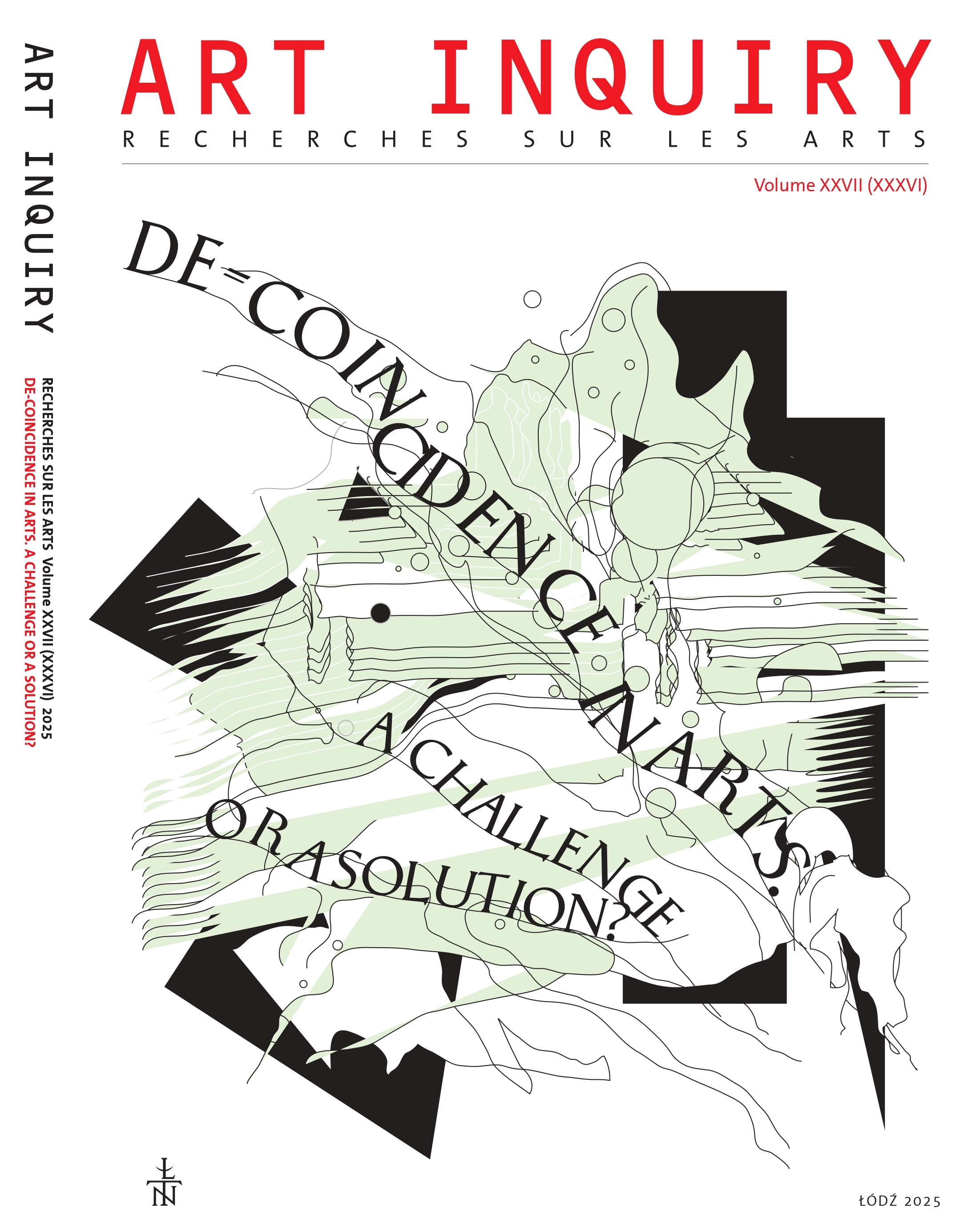

Current Issue

Vol. 27 (2025): De-coïncidence in Art: A Challenge or a Solution?
					View Vol. 27 (2025): De-coïncidence in Art: A Challenge or a Solution?

VOLUME EDITORS: Aneta Pawłowska, Paulina Sztabińska-Kałowska

Published: 2025-12-17

Part I. Theoretical Frameworks - ARTICLES

  • Art and de-coincidence: an introduction

    François Jullien
    13-28
    DOI: https://doi.org/10.26485/AI/2025/27/1
  • “Plastic Arts” or “Visual Arts”? Imaginary de-coincidence and imitation in Polish art discourse after 1989

    Łukasz Białkowski
    29-41
    DOI: https://doi.org/10.26485/AI/2025/27/2
  • Crisis and Creativity: Selected Examples of Theoretical Approaches

    Agnieszka Kuczyńska, Krzysztof Cichoń
    43-65
    DOI: https://doi.org/10.26485/AI/2025/27/3
  • Transcendentalism of Art in the Conceptions of Wilhelm Worringer and Theodor W. Adorno

    Magdalena Anna Długosz, Rafał Czekaj
    67-77
    DOI: https://doi.org/10.26485/AI/2025/27/4

Part II. International and Comparative Contexts - ARTICLES

  • The Concept of the “Flashing Ideal World”: The Experience of Ancient China for Today

    Yulia Ivashko, Wu Yueling
    81-99
    DOI: https://doi.org/10.26485/AI/2025/27/5
  • Return to National Origins in Contemporary Chinese Art and Design

    Pavol Tišliar, Zeqian Wang, Shiru Wang
    101-119
    DOI: https://doi.org/10.26485/AI/2025/27/6
  • ‘DÉ-COÏNCIDING’ Igbo Masquerade Aesthetics: Rethinking Ecological Sustainability in Southeast Nigeria

    Princewill Chukwuma Abakporo Abakporo
    121-142
    DOI: https://doi.org/10.26485/AI/2025/27/7
  • The Aesthetics of Transience in Japanese Culture: Wabi-sabi, Impermanence, and the Philosophy of Décoïncidence

    Justyna Pilarska
    143-166
    DOI: https://doi.org/10.26485/AI/2025/27/8
  • Appeal to Folk Traditions of Ornamentation in the Petrykivka Painting of the 20th Century

    Oleksandr Kashchenko, Valerii Tovbych
    167-181
    DOI: https://doi.org/10.26485/AI/2025/27/9

Part III. Case Studies - ARTICLES

  • Hugo Ball and the “Poems without Words”: On the Birth of Dadaist Art from the Spirit of Dissonance

    Magdalena Krasińska
    185-218
    DOI: https://doi.org/10.26485/AI/2025/27/10
  • De-coincidence in Poetry. Analysis of the Poem "The Pure No (El puro no)" by Oliverio Girondo

    Anna Wendorff
    219-230
    DOI: https://doi.org/10.26485/AI/2025/27/11
  • Semiotic Dissonance of Medieval Architectural Sculpture. A Case Study on the Example of the Sculptural Ensemble of the Nave Corpus of the Collegiate Church in Sandomierz

    Olga Tuszyńska-Szczepaniak
    231-254
    DOI: https://doi.org/10.26485/AI/2025/27/12
  • (De)Stabilisation of Architecture

    Julia Sowińska-Heim
    255-265
    DOI: https://doi.org/10.26485/AI/2025/27/13
  • Between Utopia and Prototype: Idea of Change in the Work of Katarzyna Kobro and Władysław Strzemiński

    Jarosław Suchan
    267-288
    DOI: https://doi.org/10.26485/AI/2025/27/14
  • Intimacy of Experience of Being Innovative Deaf Artist – The Case of American Deaf Art

    Agnieszka Kołodziejczak
    289-311
    DOI: https://doi.org/10.26485/AI/2025/27/15
  • (Not Only) Family Albums

    Ewa Szkudlarek
    313-327
    DOI: https://doi.org/10.26485/AI/2025/27/16
  • Art as an Existential Means of Perception and Experience of the Tragedy of War

    Aneta Pawłowska, Andrii Dmytrenko, Oleksandr Ivashko , Tetyana Yevdokimova
    329-348
    DOI: https://doi.org/10.26485/AI/2025/27/17
  • Towards the Phenomenology of Musical Performance

    Andrzej Krawiec
    349-367
    DOI: https://doi.org/10.26485/AI/2025/27/18

Part IV. Reflections and Future Visions - ARTICLES

  • The Art of Post-anthropocentrism: Concepts, Challenges, Dilemmas

    Ryszard W. Kluszczyński
    371-396
    DOI: https://doi.org/10.26485/AI/2025/27/19
  • Artificial Intelligence, Glitch, and the Unmaking of Identity in the Art of Mario Klingemann

    Magdalena Górska
    397-408
    DOI: https://doi.org/10.26485/AI/2025/27/20
  • Artistic Intervention for Ecology

    Sidey Myoo
    409-422
    DOI: https://doi.org/10.26485/AI/2025/27/21
  • About the Difficult Relationship Between the Polish Idea and the Polish Ethos in Contemporary Art. Marginalized Transcendentals, Critical De-coincidence, Intensive Dialogue, and Affirmative ‘Renewal’

    Rafał Solewski
    423-435
    DOI: https://doi.org/10.26485/AI/2025/27/22
View All Issues