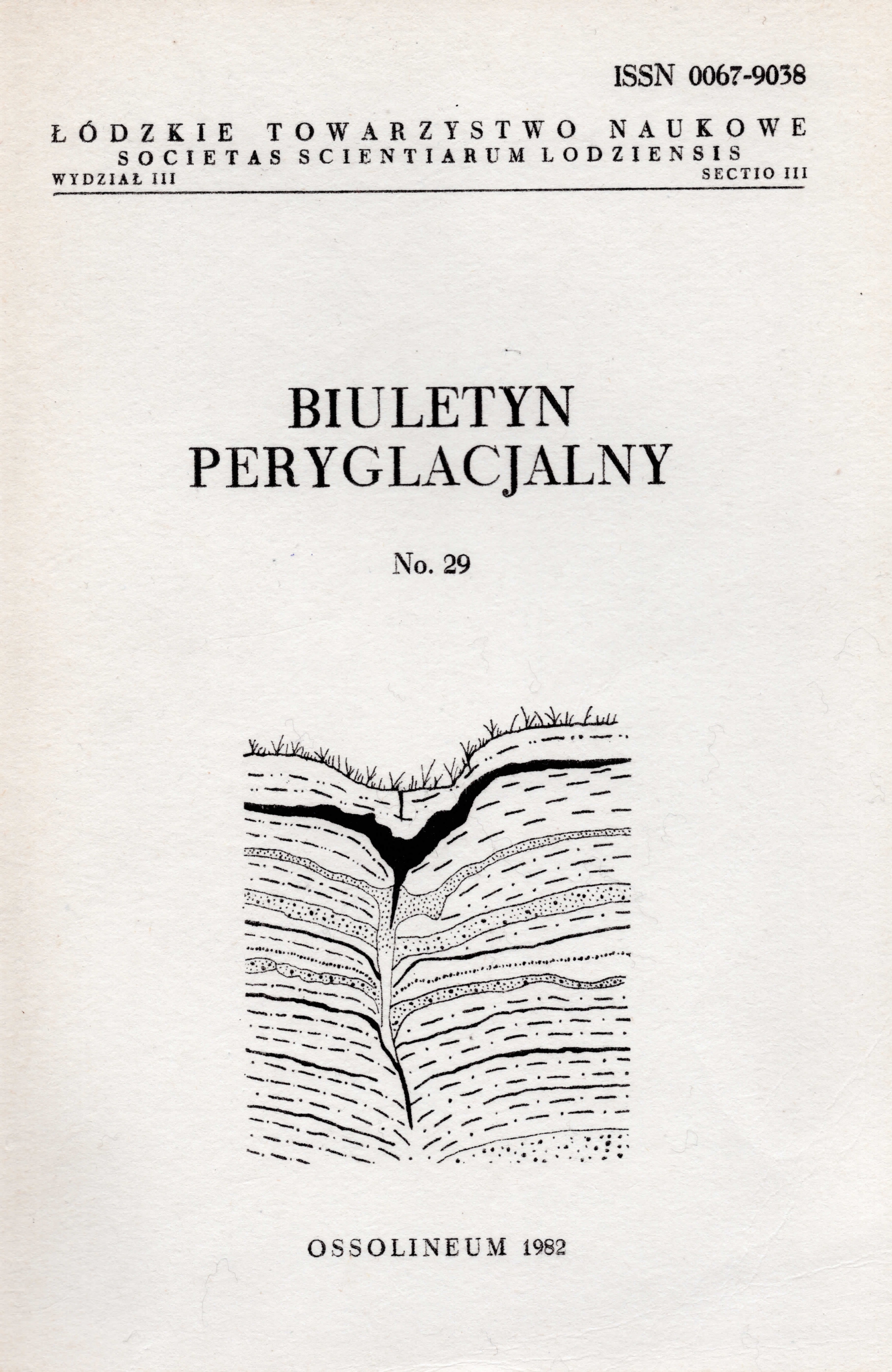
Würmian periglacial processes on the Kolno Plateau in the light of sedimentologic investigations with the use of the scanning electron microscope
DOI:
https://doi.org/10.26485/BP/1982/29/5Keywords:
grain size analysis, petrographic analysis, heavy minerals, relief of quartz grains, weathering processes, PolandAbstract
In the course of geomorphological investigations carried out on the Kolno Plateau, Poland, systems of periglacial fissure forms were distinguished within the top parts of glacial forms. Most of them may be reckoned among fissure forms of primary filling. In order to interpret the processes which have formed the deposits filling the distinguished structures a number of detailed sedimentologic analyses were made of the fluvioglacial material underlying those forms and of the material filling the fissures. The lithological type of the deposits and the relief characteristics of the sandy fraction quartz grains examined in the electron microscope show that the main process which formed the deposits filling the fissure structures was mechanical weathering with the cooperation of washing processes. The lack of any prevailing influence of aeolian processes was also stated. The high degree of quartz grain matting observed in periglacial deposits is the result of mechanical weathering which have formed highly exfoliated surfaces. The differentiated surface relief of quartz grains of fluvioglacial environment, which were the source of periglacial deposits, has thus obtained a common feature which has overlain all the previous ones.
References
Doeglas, D. J., 1968 - Grain-size indices, classification and environment. Sedimentology, 10.
Dylik, J., 1952 - Peryglacjalne struktury w plejstocenie środkowej Polski (summary: Periglacial structures in the Pleistocene deposits of Middle Poland). Biul. Inst. Geol., 66.
Dylik, J., 1963 - Nowe problemy wiecznej zmarzliny plejstoceńskiej (résumé: Nouveaux problèmes du pergélisol pléistocène ). Acta Geogr. Lodziensia, 17.
Dylik, J., Dylikowa, A., 1964 - Cechy przewodnie obszarów peryglacjalnych (summary: Dominant features of periglacial regions). Czas. Geogr., 35.
Folk, R. L., Ward, W., 1957 - Brazos River bar. A study in the significance of grain size parameters. Jour. Sediment. Petrol., 27.
Goździk, J., 1973 - Geneza i pozycja stratygraficzna struktur peryglacjalnych w środkowej Polsce (summary: Origin and stratigraphical position of periglacial structures in middle Poland). Acta Geogr. Lodziensia, 31.
Goździk, J. S., 1978 - Detailed analysis of fossil contractional frost fissures. An Instruction. Biul. Perygl., 27.
Jahn, A., 1970 - Zagadnienia strefy peryglacjalnej (Problems of the periglacial zone). PWN, Warsaw.
Kaplina, T. N., 1960 - O nekotorykh formakh moroznogo raztreskivaniya v rajonakh Severovostoka SSSR (On some types of frost-cracking in the North-East regions of the USSR). Trudy Inst. Merzlotovedeniya, 16.
Klatkowa, H., 1976 - Ślady środowiska eolicznego w rzeźbie powierzchni ziarn kwarcowych; wyniki analizy w elektronowym mikroskopie skaningowym (summary: Traces of eolian medium on quartz sand grain surfaces; results obtained with the scanning electron miscroscope). Acta Geogr. Lodziensia, 37.
Korotaj, M. 1977 - Rola procesów peryglacjalnych w przekształcaniu rzeźby środkowej części Wysoczyzny Kolneńskiej (The role of periglacial processes in relief transformation of the middle part of Kolno Upland). Inst. Nauk Fizycznogeogr. Uniw. Warsz. (manuscript).
Krinsley, D. H., Doornkamp, J. C., 1973 - Atlas of quartz sand surface textures. Cambridge Univ. Press.
Krygowski, B., 1964 - Graniformametria mechaniczna - zastosowanie, teoria (Zfs.: Die mechanische Graniformametrie - Theorie und Anwendung). Pozn. Tow. Przyj. Nauk. 2.
Krumbein, W. C., 1934 - Size frequency distribution of sediments. Jour. Sediment. Petrol., 4.
Morawski, J., 1965 - Spostrzeżenia nad odpornością i typem granatów w piaskach różnych środowisk sedymentacyjnych (Zfs.: Beobachtungen über die Widerstandsfähigkeit und die Granattypen in Sanden verschiedener Sedimentationsmileu's). Ann. Univ. M. Curie-Skłodowska, 20.
Mycielska-Dowgiałło, E., 1963 - Pomiary stopnia obtoczenia ziarn piasku i zastosowanie ich do badań geomorfologicznych (summary: Measurements of rounding of grain and the use made of them in geomorphological studies). Przegl. Geogr., 35.
Mycielska-Dowgiałło, E., 1978 - Rozwój rzeźby fluwialnej północnej części Kotliny Sandomierskiej w świetle badań sedymentologicznych (summary: Development of the fluvial relief in the northern part of the Sandomierz Basin in the light of the sedimenthological investigations). Rozprawy Univ. Warsz., 120.
Mycielska-Dowgiałło, E., Krzywobłocka-Laurow, R., 1975 - Cechy morfologiczne powierzchni ziarn kwarcowych piasku w badaniach za pomocą mikroskopii elektronowej (Surface textures of sand's quartz grains in electron microscopy). Postępy Nauk Geol., 7.
Racinowski, R., 1974 - Dynamika środowiska sedymentacyjnego strefy brzegowej Pomorza Zachodniego w świetle badań minerałów ciężkich i uziarnienia osadów (summary: Dynamics of the sedimentary environment of West Pomerania coastal zone in the light of heavy minerals and grain size distribution research). Inst. Inż. Wodnej, 4.
Racinowski, R., Rzechowski, J., 1969 - Minerały ciężkie w glinach zwałowych Polski środkowej (summary: Heavy minerals in boulder clays of Central Poland). Kwart. Geol., 13.
Turnau-Morawska, M., 1955 - Znaczenie analizy minerałów ciężkich w rozwiązywaniu zagadnień geologicznych (Significance of heavy minerals analysis in the solution of geological problems). Acta Geol. Polonica. 5.